Linux founder Torvalds refutes false rumors about tokenization: open source has never been authorized and should not become a tool for currency circle speculation
Linux founder Linus Torvalds recently issued a strong statement, emphasizing that someone in the community claimed that he had "authorized him" to tokenize and sell the code in his Git repository, which was completely false.
(Preliminary summary: 2025 Virtual Derivatives Forum "What should Taiwanese crypto derivatives users do if they leave the country? Stablecoins must maintain financial sovereignty)
(Background supplement: What will the world look like when Visa and Mastercard fully accept stablecoin payments?)
Linus Torvalds, the founder of the well-known operating system Linux Torvalds recently issued a brief public statement in response to rumors circulating in the market. On his personal Github page, he clearly denied that he had any intention to participate in or authorize any tokenization of his code (such as the Linux core), and also expressed skepticism towards cryptocurrencies.
Linus Torvalds was born in Finland in 1969 and is one of the most famous programmers in the world today. He began developing the Linux kernel in 1991 and later launched the open source project. He is also the founder and main developer of the open source project Git. 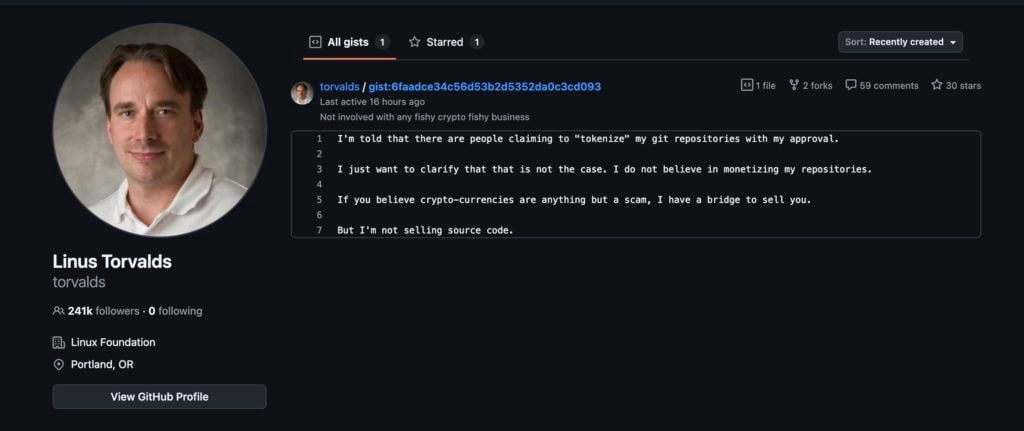
His statement read:
I’m told that there are people claiming to “tokenize” my git repositories with my approval. I just want to clarify that that is not the case. I do not believe in monetizing my repositories. If you believe crypto-currencies are anything but a scam, I have a bridge to sell you. But I’m not selling source code.
I want to be clear: this is simply not true. I will not monetize my repository code for profit.
If you really believe that cryptocurrency is more than a scam, then I have a bridge to sell you (note: this is a sarcastic way of saying that you are too good to be fooled).
But I'm not selling the source code.
The core thrust of the statement
This statement conveys the following key messages:
Publicly refutes false authorization claims
Linus made it clear that any claim that "he agreed to tokenize his source code" is false news. He himself has not participated in or authorized any similar activities.
Oppose the commercialization of program code, especially through blockchain methods
He strongly opposes the realization of open source program code "in the form of tokens or NFTs" because it goes against the spirit of open source and his values.
Extremely negative attitude towards cryptocurrencies
Using the sentence "If you believe crypto-currencies are anything but a scam...", he basically stated: He believes that the entire crypto industry is mostly a scam or hype. The phrase "I have a bridge I can sell you" mentioned after this sentence is a classic American irony, which is a metaphor for the excessive naivety of the other party.
Stick to the value of open source: Program code belongs to the public, not an asset used for speculation
He used the last sentence "But I’m not selling source code." to address the topic. Open source is not a commodity, and he has never traded program code as an asset.
This statement fully demonstrates Linus Torvalds's always straightforward, sharp and humorous personal style. Use clear language to clarify the facts and express your disdain in a humorous way. Therefore, if you really see a tokenization project related to Linux in the future, there is a high probability that it is not officially authorized (although Meme Coin does not care about this...).